
M1C Utility Trailer
Model: M1C Utility Trailer
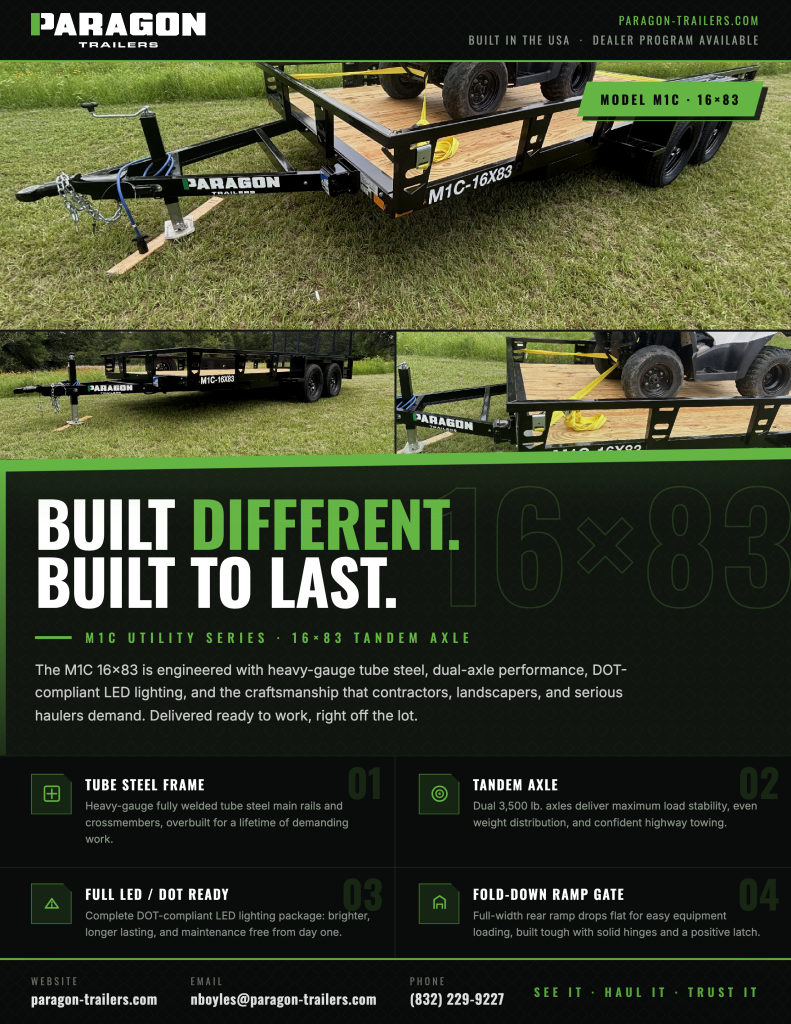
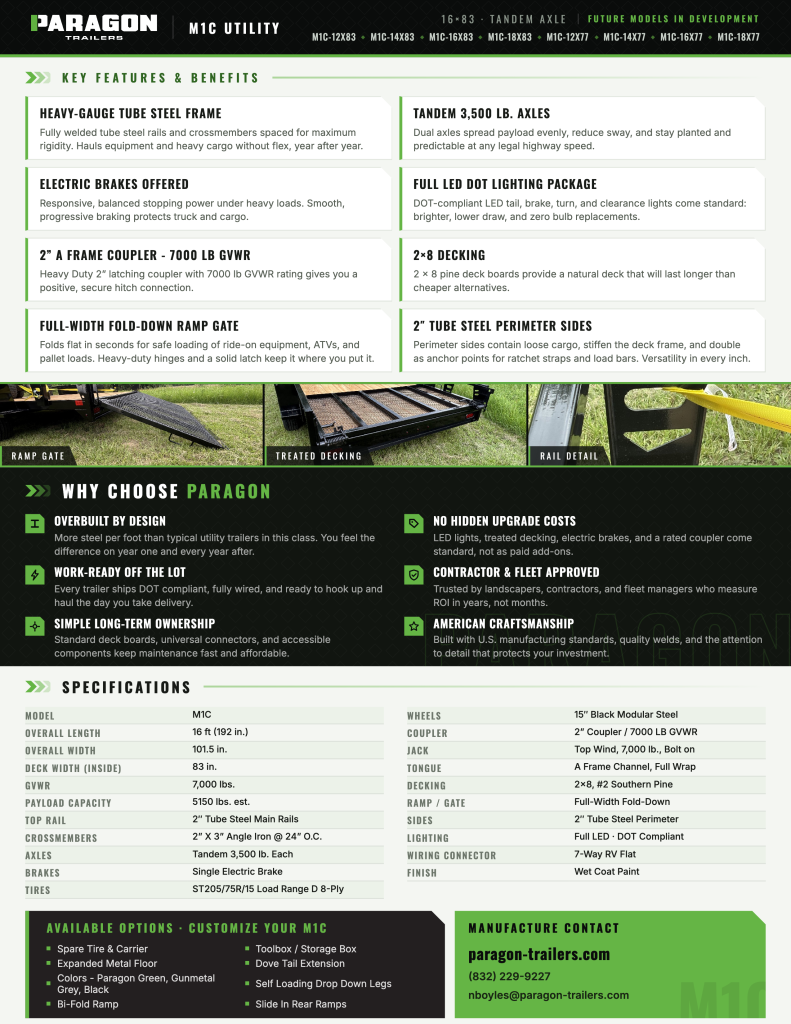
The M1C trailer was designed based off of some Legacy trailers that are out there. With that being said the M1 C has a unique strapping design that is located all the way around the trailer in approximately ten locations with this strapping design. It allows you to use just about every ratchet strap option that you can buy from Lowe’s, Home Depot, tractor supply, or Walmart. Even the ratchet straps at gas stations will work on this utility trailer design. This provides a stree free worry when you are on the road hauling your piece of equipment or moving furniture, whatever you are hauling we got you covered. These strapping locations are vertical, and are formed pockets that are spaced around the trailer that allow you to fasten your load down and in front of the fender or behind the fender or you can pull the side-by-side or motorcycle straight up to the front bulkhead of the trailer. So similar to the to the form pockets, the M1 comes with formed steel plate, fenders that are robust and are strong enough for people to walk on as they are securing their loads down. The fender features a front and back step with holes cut out in it to help with foot traction, so when it’s muddy or raining outside your foot does not slip off the fender. The fender has a reinforcement plate, in three locations, up underneath it.
This reinforcement to the utility trailer fender, provides a stable walking platform or working platform. The stable fender allows you to step out of your side by side, straight on to the fender without any worry of the fender bending. Most trailer manufacturers run a similar fender from competitor to competitor, and the fender does not allow for strapping inside the trailer. This causes the customer to strap over the fender or be limited to using other strapping locations that are not ideal for the load. The M1C fender has three holes on the inside that allow you to secure your load down without having to wrap over the top of the fender and grab the outside edge of the fender. When you strap to the outside edge of the fender, you risk bending or tearing up the fender over time. Like the fender, the rear bumper is made out of a formed piece of plate that has the tail lights and license plate light, integrated into it. Our bumper is different than most out there, our is a formed piece of plate that offers protection to the lights and a specific place to install your license plate. Most utility trailers going down the road today, have the lincese plate either hanging off of the square tube bumper or it is hanging off of the fender, in both cases, they get ripped off from these areas. If the license plate is hanging down below the bumper and you go through a low spot in the road or turn into a hardware store, you risk the license plate impacting the ground or a curb. The M1 C top rail is made out of 2” square tube x .120 wall thickness, which is at times a little bit thicker than what the common trailers are that are going down the road. At the front corners of our trailer, the top rail is metered. Unlike other utility trailer manufacturers out there, we do not do the standard butt to butt joint on the top rail.
The mitered joint we fabricate offers more weld surface area and helps promote a quality weld. When it comes to the deck that is on the M1C utility trailer, we wanted to make it easier for the customer to replace their wooden deck. Some trailer manufacturers out there bend the lumber up, and slide it under an steel piece of angle that is at the front of the trailer. This method works well, but does not work well when you need to replace the lumber. The M1C comes standard with a bolt on lumber cap. You can easily remove the bolts on the front of the bulkhead, and the lumber cap comes off and the lumber will slide out with ease. You are not having to take a metal grinder and cut out of the angle or take the trailer to a local fab shop to have them remove the angle iron. This just allows for an easier way to remove the wood without the trailer owner having to go to a local Fab shop or risk harming themselves white using a 4 1/2 inch grinder to cut this front angle out. Some trailer manufacturers that build a similar trailer to ours will either weld the jack in or it will bolt in. Some people forget to put screw the jack up after the trailer is connected to the pulling vehicle, and it hangs down. When it hangs down, it has a greater chance of impacting ditches, low drive areas, curbs while parking, or just concrete that is uneven.
When jack impacts this low area, it bends the jack and most of the time, the jack has to be replaced. Ours is a bolt on square tube style top wind jack that is welded to a piece of plate that is bolted to the cross members up in the tongue so if the jack is damaged, it can be unbolted and a new Jack can be placed in its same place and you can continue on without having to get a torch or a grinder and grinder or cut out the well to remove the jack. The lights that are on the M1 C are made by Vision LED and they are all LED lights. The fenders have two lights on them, an Amber in the front and a red bullet that is in the back. Also, at the sides of the bumper, there are two amber lights, which this really helps whenever you’re backing up the trailer at night you can see the tail end of the trailer a lot easier than other trailers. Everyone knows backing up trailers for the first time can be challenging, and very difficult by yourself at night, that is why we incorporated these lights into this utility trailer. Our wiring harness is protected in conduit all the way down the trailer. And where the conduit cannot be used, we developed a small weld on piece that allows for our operators install zip ties quickly and efficiently while installing the wiring harness. Some wire clips people use get warn out over time, especially if you are troubleshooting wiring issues. The bending of the clip back and forth, will eventually cause that light guage metal to fail. Our Paragon designed bracket is welded on, providing strength and longevity to the harness.